Quartz vs. Granite Countertops: Which Is Better for Your Kitchen?
Updated: Sep 21
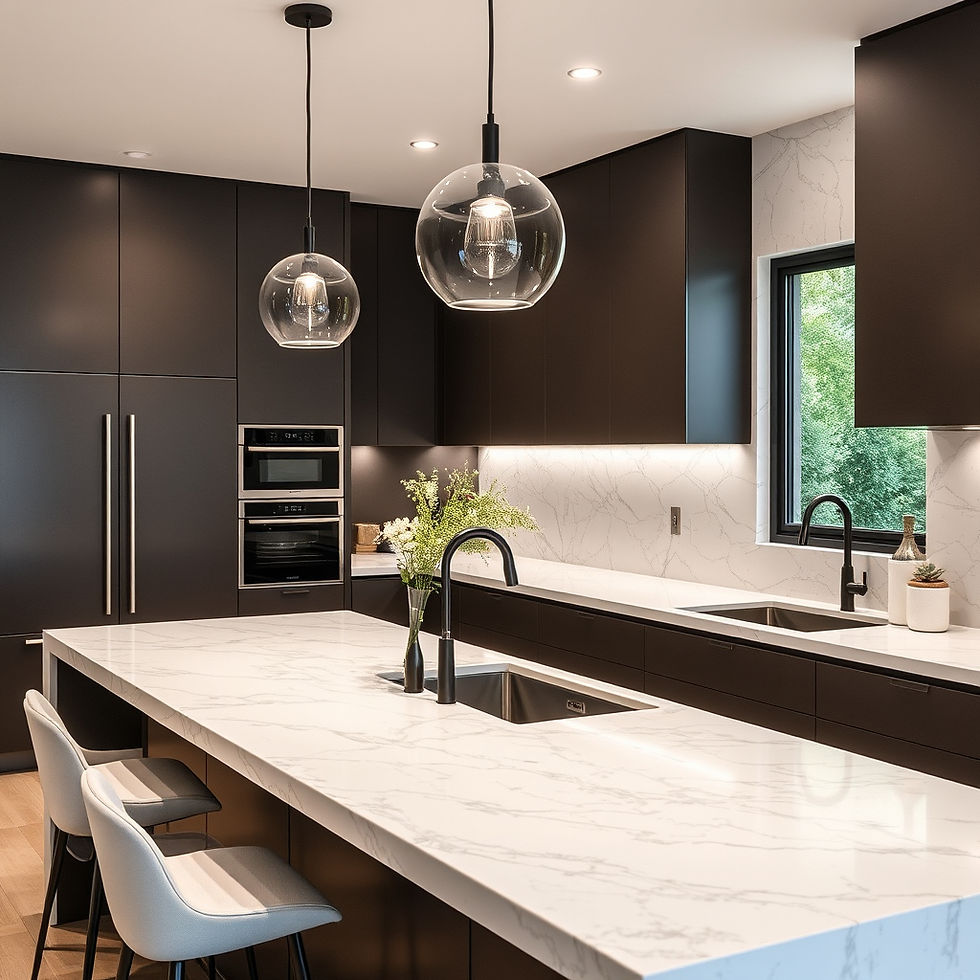
When remodeling a kitchen, choosing the right countertop is one of the most important decisions you’ll make. Your countertops need to look beautiful, fit your design, and stand up to everyday use.
Two of the most popular choices are quartz and granite countertops. Both offer durability and a high end appearance, but they have important differences when it comes to maintenance, appearance, heat resistance, and customization.
So, which one is better for your kitchen?
The answer depends on your lifestyle, design preferences, and how you use your kitchen. In this guide, we’ll compare quartz vs. granite countertops to help you choose the right surface for your home.
What Is a Quartz Countertop?
Quartz countertops are engineered surfaces made primarily from natural quartz combined with resins and other materials. Because they are manufactured, quartz countertops are available in a wide variety of colors, patterns, and styles.
One of the biggest advantages of quartz is consistency. If you want a countertop with a clean, modern appearance or a marble inspired design, quartz can provide a very uniform look.
Quartz is also nonporous, which means it does not readily absorb liquids or stains. This makes it a popular choice for busy kitchens.
Advantages of Quartz Countertops
Easy to clean and maintain
Resistant to many common kitchen stains
Nonporous surface
Wide selection of colors and patterns
Consistent appearance
No routine sealing required
Excellent option for modern and contemporary kitchens
Quartz is especially popular with homeowners who want the appearance of natural stone while keeping maintenance relatively simple.
What Is a Granite Countertop?
Granite is a natural stone that is quarried from the earth and cut into slabs for countertops. Because it is a natural material, every granite slab has its own unique colors, patterns, and mineral variations.
This natural variation is one of granite’s biggest advantages. No two slabs are exactly alike, which can give your kitchen a distinctive and luxurious appearance.
Granite is also extremely durable and can handle the demands of a busy kitchen when properly cared for.
Advantages of Granite Countertops
Natural stone with unique patterns
Excellent durability
Strong resistance to scratches
Excellent heat resistance
Available in many colors and patterns
Each slab is unique
Adds a natural, high end appearance to a kitchen
For homeowners who love the character and natural variation of stone, granite can be an excellent choice.
Quartz vs. Granite Countertop: Which Is More Durable?
When comparing quartz vs. granite countertops for durability, both materials perform well in everyday kitchens, but they have different strengths.
Quartz is highly resistant to scratches and everyday wear. Its nonporous surface also makes it easy to maintain.
Granite is naturally very hard and is also highly resistant to scratches and normal kitchen use. One of granite's biggest advantages is its ability to withstand high temperatures.
However, neither countertop should be treated as indestructible. Using cutting boards, trivets, and proper cleaning products can help protect your investment and keep your countertops looking great for years.
If low maintenance is your top priority, quartz is usually the easier option.
Because quartz is nonporous, it does not require routine sealing. For everyday cleaning, a soft cloth or sponge with mild soap and water is generally sufficient.
Granite can also be easy to maintain, but natural stone may require periodic sealing depending on the specific granite and sealer used. Proper sealing helps protect the stone from staining and moisture absorption.
For homeowners who want the simplest maintenance routine possible, quartz may have an advantage.
Which Is More Heat Resistant: Quartz or Granite?
This is one area where granite generally has the advantage.
Granite is a natural stone and can withstand high temperatures. However, it is still a good idea to use a trivet or heat pad when placing extremely hot cookware on your countertop.
Quartz contains resins as part of its manufacturing process. High heat can potentially damage the surface or cause discoloration.
For this reason, you should always use a trivet when placing hot pots, pans, or baking dishes on a quartz countertop.
Which Has More Design Options?
Both materials offer many design possibilities, but they create different looks.
Quartz is manufactured, allowing manufacturers to create a wide range of colors and patterns. Many quartz designs are made to resemble natural marble, granite, or other stones.
Granite offers something different: natural variation.
Each slab can contain unique mineral patterns, colors, movement, and veining. If you want your countertop to be completely unique, granite is an excellent option.
Your choice may ultimately come down to whether you prefer the controlled, consistent appearance of quartz or the natural character of granite.
Quartz vs. Granite: Which Is Better for a Busy Kitchen?
For a busy household, both materials can work extremely well.
Quartz is an excellent choice if you want easy everyday maintenance, a nonporous surface, consistent colors and patterns, a modern appearance, and minimal maintenance.
Granite may be a better choice if you want natural stone, unique patterns and colors, excellent heat resistance, a traditional or natural appearance, and the character of a one of a kind slab.
The best countertop isn't necessarily the material with the most advantages. It's the material that fits your specific kitchen and lifestyle.
How Much Do Quartz and Granite Countertops Cost?
The cost of a countertop project depends on several factors, including the material you choose, slab selection, countertop size, edge profile, sink cutouts, backsplash, installation, demolition, and the complexity of the kitchen.
Quartz and granite are both available at different price levels, so comparing the cost of the entire project, not just the price per square foot, is important.
A professional countertop company can help you understand the complete cost of your project and identify options that fit your budget.
Which Countertop Should You Choose?
There isn't one countertop material that is perfect for every homeowner.
Choose quartz if you prioritize low maintenance, a nonporous surface, and a wide selection of consistent designs.
Choose granite if you prefer natural stone, unique patterns, and excellent heat resistance.
If you're still undecided, looking at actual slabs in person can make the decision much easier. Photos don't always show the true color, movement, texture, and character of a stone.
Upgrade Your Kitchen with OG Design & Build
At OG Design & Build, we help homeowners create beautiful, functional kitchens with quality countertop and remodeling solutions.
Whether you're considering quartz, granite, quartzite, or another countertop material, we can help you choose an option that works with your kitchen design, lifestyle, and budget.
From countertop selection and fabrication to installation and kitchen remodeling, our goal is to make the process straightforward from start to finish.
Ready to upgrade your kitchen?
Contact OG Design & Build today to discuss your countertop or kitchen remodeling project.
Final Thoughts
Quartz and granite are both excellent countertop materials. Quartz offers easy maintenance and a wide variety of manufactured designs, while granite provides the natural beauty and unique character of real stone.
Choosing between quartz vs. granite countertops comes down to your priorities: appearance, maintenance, daily use, and budget.
Before making your final decision, consider how you use your kitchen, how much maintenance you're comfortable with, the style you're trying to achieve, and your overall remodeling budget.
With the right countertop, you can transform the appearance of your kitchen while creating a durable surface designed for everyday life.

Comments